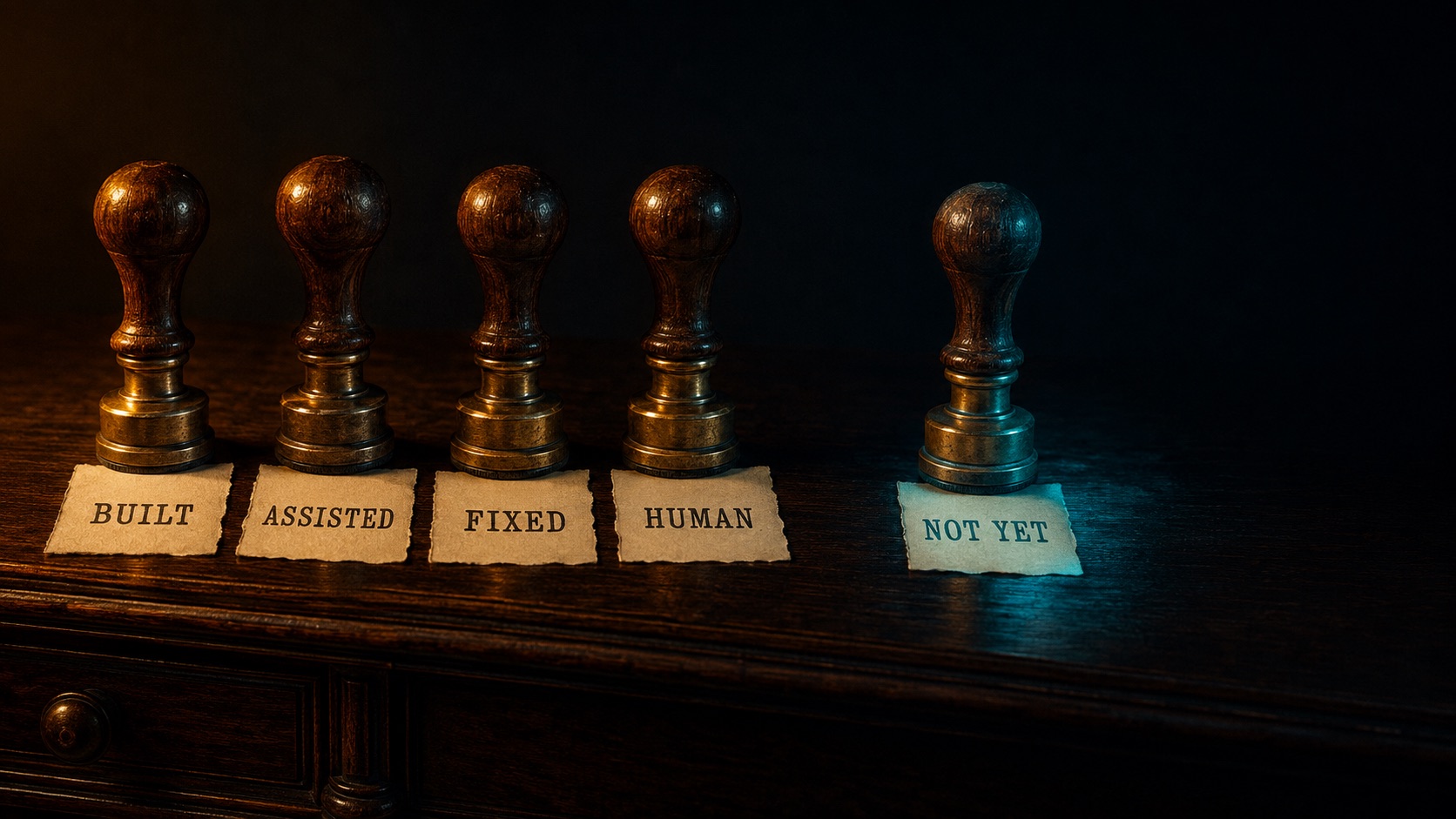
Don't automate work where the judgement is the value, decisions nobody will genuinely review, jobs that are merely annoying rather than heavy, processes that are already broken, conversations that are part of the service, the work juniors learn the profession by doing, or anything whose economics won't survive the maintenance bill. Automate the work around the judgement before you automate the judgement itself.
Finding work AI can do turns out to be the easy half of adoption. Point at almost anything in a professional services firm and some tool will volunteer. The harder half is knowing which work it shouldn't touch.
I run a practice built on AI agents, so I've no interest in talking you out of the technology. I have a lot of interest in where firms point it, because pointed at the wrong work it doesn't just waste money. It removes judgement, accountability, trust, and learning from places that quietly depended on them, and those don't come back with a rollback.
So here are the seven tests I actually use. Each one is a reason to keep work human, and behind them all sits one principle worth remembering after you've forgotten the rest:
Automate the work around the judgement before you automate the judgement itself.
1. Don't automate work where the judgement is the value
Plenty of professional work has admin crusted around the edges and a decision at the centre. Giving the advice. Deciding whether the candidate is right. Reading an ambiguous client situation. Choosing what to recommend, and what to leave unsaid. Handling the exception that's never come up before.
AI can prepare all of that superbly: gather the file, summarise the history, test a draft against the checklist, argue the other side. What it shouldn't do is make the call, because the call is the product. When a client pays your firm, the judgement is the line item. Removing it isn't efficiency, whatever it does to the timesheet.
Clear the admin off the edges and the professional gets more time inside the decision.
2. Don't automate consequential decisions nobody will genuinely review
"A human stays in the loop" is easy to say and hard to mean. Here's how it actually goes: the reviewer reads the first output carefully, the tenth quickly, and by the two-hundredth, on a Friday, they're approving the shape of the page. That's a rubber stamp, not a review.
So the useful question goes a layer deeper: could a person realistically catch this system being wrong? If the volume is too high to read properly, or the error looks exactly like a correct answer, the answer is no.
High consequence plus invisible error is the worst combination there is, and it's the territory I've called work that fails quietly: the filing date, the calculation nobody re-checks, the clause that was fine last year. Where a mistake would surface months later in front of a client, keep a person doing the work, not watching it. This is most of what The Seven Shifts™ mean by accountability.
3. Don't automate something just because people hate doing it
Irritation is loud and cost is quiet, and firms routinely confuse them.
A job can be genuinely hated, come up twice a month, and take fifteen minutes. Build an agent for it and you've spent real money, added a system that needs minding, and recovered six hours a year. Meanwhile the twenty-minute job nobody complains about, done daily by three people, eats 184 hours a year in silence.
Count before you decide: how often, how long, how many people. The calculator does the sum in two minutes if you want to see it for one task.
4. Don't automate a broken process
Some work is painful because it's badly designed, and automating a badly designed process gets you the same bad process running faster.
You'll recognise the signs: an approval step nobody can explain, the same details typed into two systems, hand-offs where things go missing, exceptions that have quietly become the rule. AI layered on top of that doesn't fix any of it. It industrialises it.
This is why every job in a firm deserves one of five answers, not two. The five-way sort: automate it, assist it, fix the process, keep it human, or leave it alone for now. In practice, fix-the-process claims more jobs than anyone expects walking in, and it's often the cheapest fix on the list: a half-day with the people involved, and nothing to maintain afterwards. The method's written up here.
5. Don't automate work where the conversation is part of the service
Sometimes the client needs more than the answer. They need it explained, by a person they trust, with room to push back.
The accountant talking a client through a cash problem. The solicitor explaining an uncomfortable position. The consultant pushing back on a CEO who's expecting agreement. The architect on the phone to someone unhappy about a delay. In every one of those, part of what's being bought is reassurance, challenge, and a person willing to put their name to the recommendation and stay in the room while it lands.
AI can prepare those conversations brilliantly, and it should: the history assembled, the numbers ready, the options laid out. The conversation itself is the service. Send a machine to have it and the client has learned something about how much the relationship is worth to you.
6. Don't automate the work people learn the profession by doing
This one is quieter.
A lot of junior work looks automatable precisely because it's repetitive: the research, the first drafts, the document review, the assembling of an argument. But those repetitions are how a trainee becomes the professional whose judgement you'll be selling in ten years. The senior people in your firm can smell a wrong number because of the thousand spreadsheets they built by hand.
Hand all of the apprenticeship work to AI and the sums look wonderful this year. What you've actually done is stop manufacturing your future seniors. The question to ask of any automation that touches junior work: are we removing drudgery, or removing the repetitions that expertise is made of? Some of each is usually the answer, and the line between them deserves a partner's attention, not a procurement decision.
7. Don't automate what the maintenance bill will kill
An automation that works in the demo still has to survive contact with the calendar: the subscriptions, the model costs, the integration that changes under it, the drift in its behaviour, the monitoring, the person who supports it when someone's stuck, and the human review you promised in test two. That bill arrives monthly, forever, whether or not the automation is still earning anything.
The question that decides it comes later: does it still earn its place six months on? If the answer turns out to be no, retiring it should be a normal, unembarrassing act. The Fleet runs on exactly that rule in my own practice: everything deployed keeps justifying itself, or it goes.
So what should you automate?
After seven tests of caution you might expect me to recommend a life of hand-copying. The opposite: the point of knowing what to leave alone is that you can move with real speed on everything else.
The best early candidates share a shape. They're frequent. They're repetitive and reasonably predictable. They're expensive in aggregate rather than dramatic in the instance. A mistake is low-consequence, visible, and reversible. A person can verify the output quickly. And they sit beside valuable human work rather than replacing it.
In practice that means the chasing of missing information, meeting briefs, document preparation, notes turned into actions, first-pass sorting and classification, the gathering end of research, and the assembly of recurring reports. I've written up fifteen of them, rated one by one.
And the poor early candidates are the seven tests read back: final advice, the difficult conversations, decisions about people, irreversible commitments, and any judgement running unsupervised where the consequences are real.
Where a machine earns its place
The goal was never to find everything AI can do. The goal is to decide where a machine has earned the right to participate in your firm's work, and to be able to say why, out loud, to the people whose names are on the door.
When I finish that exercise inside a firm, the outcome against any given job reads one of five ways: built, assisted, process fixed, left human, or not yet. Every one of those is a result.
If you want someone to run the sorting with your team, that's a Census day: your people, one table, every recurring job counted and given its answer. And if you just want to test one suspicion first, the calculator is free and takes two minutes.