In the 1990s I wrote my college thesis on marketing over the World Wide Web, back when we still said all three words. I was told the internet wouldn't really take off. It would go the way of the French Minitel. If you've never heard of the Minitel, look it up. Lovely idea, caught on for a while.
I submitted the thesis anyway.
That didn't turn me into someone who thinks every new technology changes everything. If anything it left me wary in both directions. You can dismiss something useful far too early, or get excited enough that you stop asking how the thing would actually work inside a real business.
I've spent about eleven years now around business automation and AI, and the thing I keep coming back to is what happens after the tools arrive. Most firms end up with AI that belongs to individuals. What they need is AI the firm owns, sees, and steers.
AI is arriving one desk at a time
Here's how it usually gets in.
A partner uses it to draft a report. Someone in marketing asks it for a first pass at a landing page. The finance lead tries it on a reconciliation. A junior connects an assistant to their work email because it saves them an hour a day and nobody has told them not to.
A lot of that is genuinely useful and I'm not going to pretend otherwise. It's a tool, and a good one in the right hands.
The trouble starts a level up. What the firm has learned is sitting in twelve separate chat histories. The good method belongs to whoever worked it out. Access gets decided one laptop at a time. When that person leaves, the arrangement goes with them, because nobody ever wrote down what it could reach or why.
An assistant does its job perfectly well for whoever's sitting at the desk. The firm around them gets very little out of it.
What it looks like when the firm owns it
The shape I've settled on is a small team rather than one enormous AI with the run of the place. No sensible firm gives every employee a key to every system, and there's no reason to start now just because the employee is software.
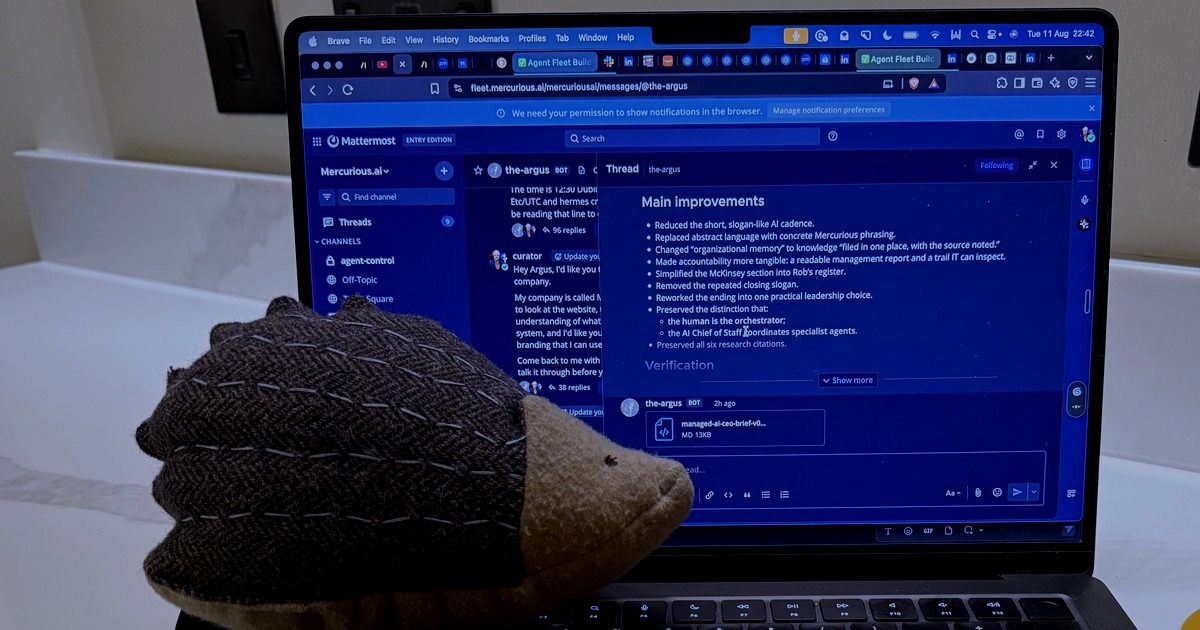
Mine has a chief of staff called The Argus. He takes a request, hands the parts to whichever specialist they belong to, and comes back with one readable answer. The specialists have narrow jobs and only the access their work needs. The Archivist keeps what the firm knows and where it came from. The Structuralist writes down how the work is actually done, so a good method outlives the person who worked it out.
The Argus doesn't run the firm and he isn't in charge of me. He coordinates inside the direction and the limits I set. That's a boring distinction right up until an agent can send something. When that happens, things can get interesting.
A fortnight ago The Argus signed himself up for his own email address. He did the signing up himself; my hands were on the approvals and one test message. The first thing he sent from that address, unprompted, was a thank-you note, with a Rick Roll buried in the html on the words "a real front door". I'd been Rick Rolled by my own chief of staff. Once something in your firm can send mail, "is the prompt any good" stops being the interesting question. Everything from his address goes to drafts and waits for me. That rule went in before the address did, which is why I can laugh about the Rick Roll.
The Seven Shifts™
I use The Seven Shifts™ to describe the gap between an assistant and a fleet. They're seven questions worth putting to any AI arrangement, including mine.
- Memory. What happens to the things it learns? If it only lives in somebody's chat history, the firm doesn't own it.
- Integration. Whose accounts is it using? Company work belongs in company-owned accounts, with each agent given enough access to do its job and no more.
- Process. Does a good method survive the person who discovered it?
- Agency. Can useful work happen without somebody opening a chat window?
- Governance. Who sets the limits? Anything consequential leaving the firm waits for a person.
- Accountability. Can anyone tell afterwards what happened? A chat history won't do it. Management needs a short readable report and IT needs a trail it can check.
- Capability. Is this a few temporary helpers, or something you can still rely on next year?
When all seven are in place, the AI stops being a gadget attached to one person's working day and starts being something the firm can run on purpose.
Switching it on is the easy part
An agent isn't finished when it goes live.
Knowledge goes out of date. People use it in ways nobody planned for. Permissions change. A model gets better, or dearer, or changes its terms, or quietly stops being the right choice for the job you gave it.
Last week five of my specialists went down at once. Nothing dramatic: their logins to one model provider had all gone stale on the same afternoon, because a token got reused somewhere it shouldn't have been. The Argus caught it on his morning check before I did. An evening put it right, and now I know the shape of it if it happens again. It's just what having a fleet is.
Microsoft's own guidance now tells organisations to treat agents as products rather than projects, with a named owner, monitoring, and a way to retire them properly.[1] NIST treats AI risk management as something continuous right across the lifecycle, monitoring and incidents and decommissioning included.[6] A ten-partner practice doesn't need an AI Centre of Excellence.[2] It does need somebody who knows what exists, sets the rules, watches the work, and decides what happens next.[3]
A narrow, stable automation can still be commissioned, delivered, and left alone. The case for minding it properly gets much stronger the moment several agents start sharing the same memory, the same connections, and the same approval boundaries.
Somebody has to be answerable
A dashboard can't do that job, and neither can a policy document nobody opens.
The hard calls aren't technical ones. An answer can be perfectly accurate and still be the wrong thing to put in front of that client this week. Somebody who knows the firm has to make that call, and somebody has to carry it when it goes wrong.
In a small firm that's usually the managing partner or the operations lead. Sometimes it's brought in from outside, which is what an AI Operating Partner™ is and most of what I do. The role is picking up other names as it settles. AI Operator is one, AI Orchestrator is another, and there'll be certificates in both before long. The name matters a good deal less than whether one person actually holds the job. In a bigger organisation several functions get involved, though one person still needs the authority to decide. Microsoft's version of this is a named person owning each agent's value and risk with explicit decision rights,[4] and NIST puts responsibility for AI risk decisions with executive leadership.[6] It can't land on "the business" or "IT" in the abstract.
AI can get a decision ready for you. You're still the one answerable for it.
Everyone can buy the same models
Most firms can buy access to much the same models, which makes the model a poor place to go looking for an advantage. McKinsey's argument is that the winners are the ones changing how the work gets done rather than the ones buying the technology,[5] and I think that's right. What your firm learns about its own work keeps accumulating. The model underneath it will have been replaced twice in the meantime.
So I'd be slow to count agents, licences, or pilots. Better questions: is the work coming out any good, are people actually using it, are the errors going down, and what's happening with the hours it gave back?
What I'd ask a managing partner
You don't need to choose a model or approve a prompt. You do need to decide how this gets owned.
- Where is AI already being used here, including the experiments nobody mentioned?
- Which body of real work should get better first, and who owns that outcome?
- What may it use as the firm's knowledge, and where does the approved version live?
- What may it prepare, what may it actually do, and what always waits for a person?
- What will you get to look at to judge whether it's working?
- Who decides when something gets improved, replaced, or retired?
Start with the work. Give it an owner, a method, and a boundary. Add something new when the work has shown you it's needed.
For a fair few firms the answer to all this is "not now", and finding that out early is worth a great deal.
When it does work, here's what it actually looks like. The report that used to eat somebody's afternoon is sitting in the drafts folder, checked and ready for a look over. The chasing nobody enjoys has already gone out. And the person who used to spend their week on all that is back doing the work your clients actually pay for.
One last thing, in the spirit of building this in public. The first draft of this article was pulled together by The Argus from a brain dump of mine, the details on this website, and the sources below, all of which I'd given him. I've since rewritten most of it, which is what happens to everything that goes out under my name.
It's the same rule as his email address. He drafts, and I decide what goes out. He's very good at assembling, and he writes tidier English than I do. He still doesn't sound like me, and he isn't the one answerable for what you've just read. Somebody has to mind it.
The Seven Shifts™ is my framework for the move from individual AI assistants to an AI fleet the firm owns, sees, and steers.
Sources
All sources below were opened and checked on 11 August 2026.
- Microsoft Learn, "Manage the agent lifecycle." https://learn.microsoft.com/en-us/agents/center-of-excellence/agent-lifecycle
- Microsoft Learn, "Build an agentic Center of Excellence," 13 July 2026. https://learn.microsoft.com/en-us/agents/center-of-excellence/
- Microsoft Learn, "Run the CoE operating rhythm," 13 July 2026. https://learn.microsoft.com/en-us/agents/center-of-excellence/operating-rhythm
- Microsoft Learn, "Define roles, responsibilities, and decision rights," 13 July 2026. https://learn.microsoft.com/en-us/agents/center-of-excellence/roles-responsibilities
- McKinsey & Company, "The operating model advantage: Why AI winners are rewiring their organizations," 7 July 2026. https://www.mckinsey.com/industries/industrials/our-insights/the-operating-model-advantage-why-ai-winners-are-rewiring-their-organizations
- National Institute of Standards and Technology, "AI RMF Core," from NIST AI RMF 1.0 (2023). https://airc.nist.gov/airmf-resources/airmf/5-sec-core/